
The Hayabusa Compass
Nine lenses. One considered judgment.
A strong business can be a poor investment at the wrong price. A sound thesis can arrive too early. The Compass brings the forces behind an investment into view—so we can ask better questions before committing capital.
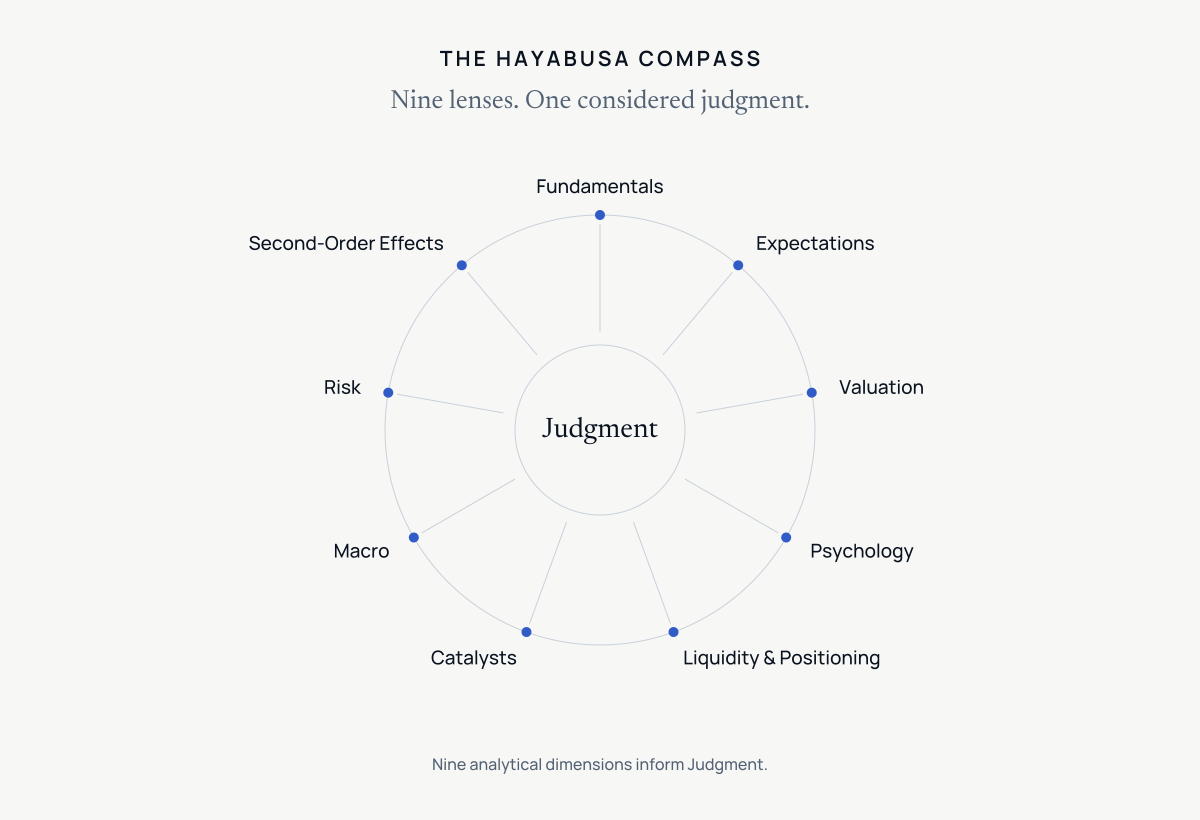
Judgment at the Center
The nine dimensions organize the inquiry. Judgment weighs the evidence, resolves competing explanations, and identifies what remains uncertain. Their importance varies with the company, the market, and the decision.
We use the Compass to make those tensions explicit. It does not produce an aggregate score, prescribe an allocation, or promise a prediction.
The Nine Dimensions
Fundamentals
What is happening inside the business? Examine demand, margins, cash generation, balance-sheet strength, and the durability of its economics.
Expectations
What does the market already believe? Identify the outcome embedded in the price—and what would exceed or disappoint it.
Valuation
What are we being asked to pay? Compare plausible outcomes, their assumptions, and the downside if the thesis falls short.
Psychology
How are investors interpreting the evidence? Look for fear, enthusiasm, complacency, and narratives that may overwhelm the facts.
Liquidity & Positioning
Who owns the asset, and who may need to buy or sell? Consider market liquidity, crowded positions, and the forces setting the marginal price.
Catalysts
What could change the market’s view—and when? Separate a scheduled event from evidence that could materially alter the thesis.
Macro
Which economic and policy forces matter? Trace how rates, credit, currencies, and the broader market environment affect the investment.
Risk
What could permanently impair capital? Examine financing needs, failure scenarios, and what would invalidate the thesis. Keep survival first.
Second-Order Effects
What happens next? Follow who benefits, who pays, which bottlenecks emerge, and where the economic value ultimately accrues.
How to Read Our Research
Start with the gap between the evidence and the expectations reflected in the price. Then look for what could close that gap, what could prevent it, and what would change our judgment.
Company quality and stock attractivenessA good business still needs a defensible purchase price.
Long-term conviction and timingA thesis can be sound while the near-term setup remains unfavorable.
Evidence and inferenceSeparate what is established from what we think it implies.
Decision quality and outcomeA good result alone does not validate the reasoning that produced it.
A Compass Reading
A Compass Reading is the planned recurring application of this framework: what has changed, which dimensions matter most, and what evidence we need next. The framework is established; the recurring publication is still to come.